01
16.S893Sheet 01 of 12Session
Session 09 · Thursday 8 October 2026
Specialized agents, continued
16.S893AI Agents for Engineering Research
02
16.S893Sheet 02 of 12Session
Today
Today
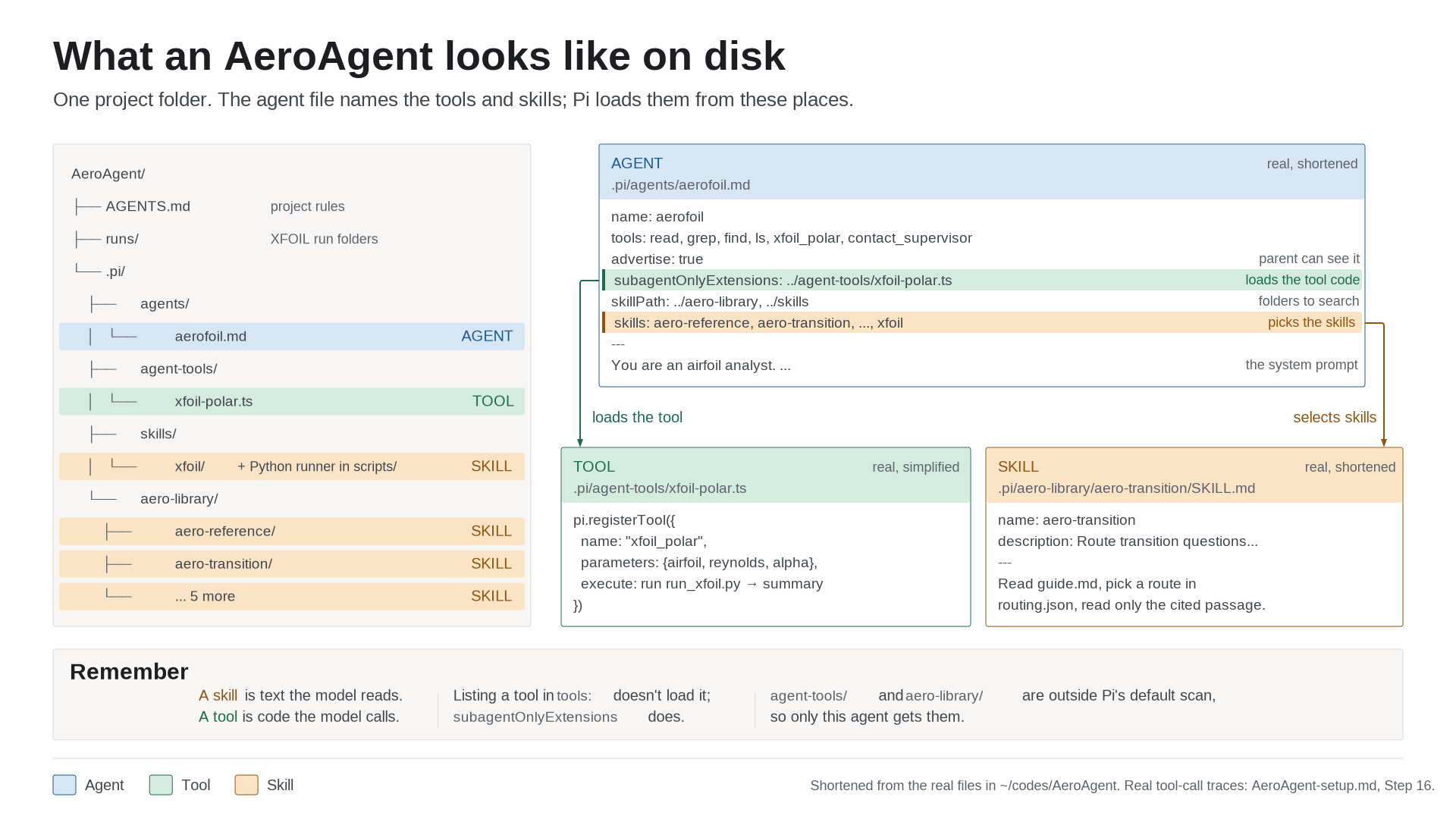
- AeroAgent on disk: agent, tool, skills
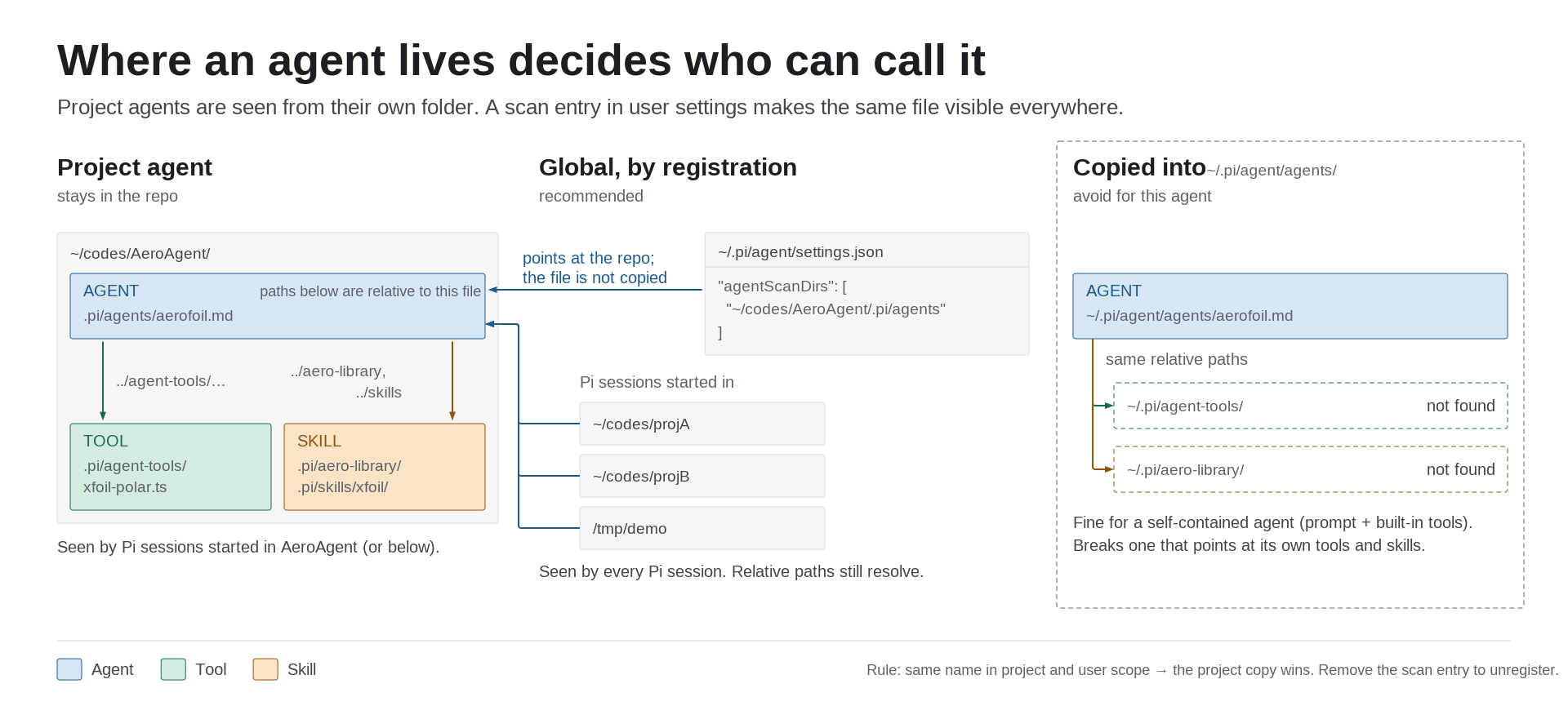
- Where an agent lives, and who can call it
- When you need any of this
- Groups: finish the issues, 30 minutes
- Report out, one item per group
03
16.S893Sheet 03 of 12Session
04
16.S893Sheet 04 of 12Session
05
16.S893Sheet 05 of 12Session
Do you need a subagent?
Do you need a subagent?
- Not everyone does. Know the technique; use it when it fits
- To write some throwaway code: just ask an agent to write it
- For elaborate, repeated or research-quality work: skills, tools, agents
- Good fit: read-heavy, separable, checkable
- Costs: may use more tokens in total, lossy handoffs, a poor fit when each step needs the last step’s details
06
16.S893Sheet 06 of 12Session
Part 03, continued
Your project
07
16.S893Sheet 07 of 12Session
In groups · by project type
Groups
| Group | Members | What the projects share |
|---|---|---|
| A | Kevin, Ruizhe, Allegra, Shreya | Public datasets and long data pipelines |
| B | Madison, Grace, Kazuki | CFD solvers and interpretation |
| C | Bjarni, Anna, Nathanael | A simulation code to wrap, checked against published or existing numbers |
| D | Michael, Stephen, Hugh, Naomi | A training or build loop the agent sets up, launches and summarizes |
| E | Ben, Menna, Ufuk | A formulation or controller checked for meaning and problem validity |
08
16.S893Sheet 08 of 12Session
In your group · 30 minutes
One skill, one tool, one agent
In your group
- Pick a notetaker, who takes notes and reports out
- Keep time: 30 minutes, and go through each person’s project
- The notetaker opens an issue on each person’s repo
The issue
Title: Idea: <skill / tool / agent> for <the step>

- What I do by hand today:
- Skill, tool or agent, and why:
- In → out:
- The test I'd approve:
- Smallest version I could build this week:

Group members: <names>
Rough is fine. It is just a reminder, and it helps your colleague.
09
16.S893Sheet 09 of 12Session
Report out · 10 minutes
One item per group, two minutes
- What they do by hand today
- Skill, tool or agent, and why
- What goes in, what comes out
- The test they would approve
10
16.S893Sheet 10 of 12Session
Ideas and techniques so far
| Technique | Session | The rule |
|---|---|---|
| Context | 2, 3 | All the model knows about your problem is in the window |
| Skill | 3 | A file the model reads when the task matches |
| Sandbox | 4 | Limit what a wrong tool call can do |
| Approved tests | 6 | The agent proposes tests; you approve them |
| Task file | 7 | One task, one fresh session, one approved test |
| Tool, script, agent | 7 | Where does the output go? A schema, a file, a fresh context |
11
16.S893Sheet 11 of 12Session
References
- Anthropic, Building effective agents, 2024
- Anthropic, How we built our multi-agent research system, 2025: the token cost
- pi, Extensions: registering a tool
- pi-subagents on npm
12
16.S893Sheet 12 of 12Session
Before next Thursday
Build
Prototype the idea from the issue your group opened on your repo: the smallest version of the skill, tool or agent. Put it on your website, and reflect on it in your dev log: what you built, whether it passes your verification, and what you would change or improve in the future.