1. When Lightning Strikes
Aircraft lightning strikes are probably more frequent than you'd expect, but thankfully modern aircraft are well-protected against catastrophic lightning damage.
per commercial aircraft
Strikes triggered by the presence of the aircraft
Probability of catastrophic failure due to lightning
In 90% of cases, the aircraft 'triggers' the lightning strike and lightning leaders grow from the aircraft surface.
As the aircraft moves forwards, the lightning channel is swept over the surface.
Burning, pitting, melting, acoustic shockwaves, and composite delamination occurring immediately at lightning arc attachment points.
Electromagnetic interference and computer failure induced by severe transient magnetic fields and currents coupling into onboard wiring harnesses and avionics.
2. Lightning Zoning
The first stage in aircraft lightning protection is zoning. We divide the aircraft into 3 zones (6 sub-zones) based on the localized lightning risk.
| Zone | Sub-Zone | Definition |
|---|---|---|
| Zone 1 Initial attachment and first return stroke | 1A | First return stroke |
| 1B | First return stroke with long hang-on | |
| 1C | Transition zone | |
| Zone 2 Swept stroke | 2A | Swept stroke |
| 2B | Swept stroke with long hang-on | |
| Zone 3 Conducted current | 3 | Direct attachment unlikely, but some conducted current |
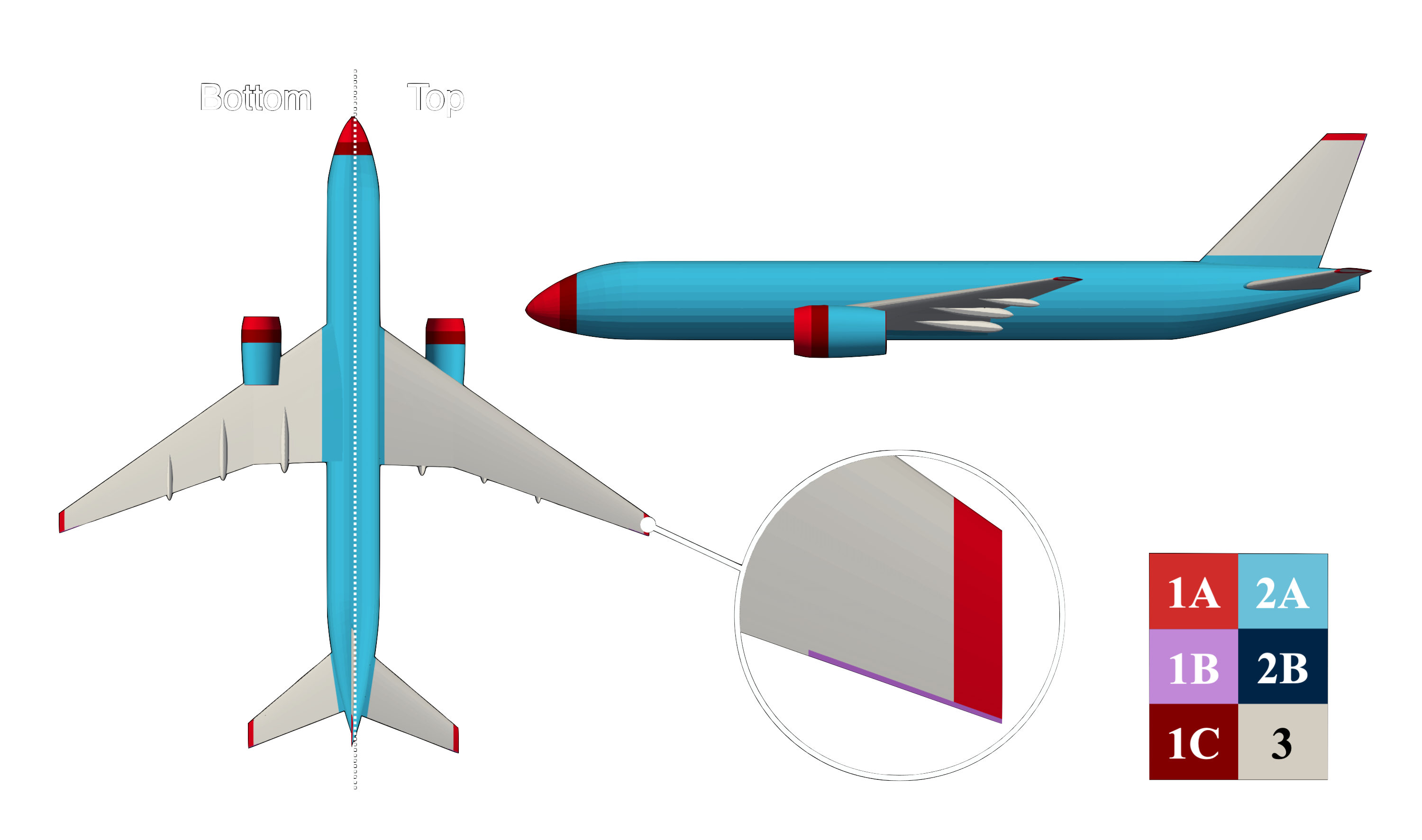
We usually zone aircraft by 'similarity', which means copying similar, existing aircraft with in-service experience. This won't work for next-generation aircraft with unconventional shapes.
3. Simulation Methods
Simulations provide three key benefits to aircraft lightning zoning:
- (1) They are generalizable to arbitrary aircraft geometries.
- (2) They are physics-based and could help reduce over-conservativism.
- (3) They are quantifiable and produce more repeatable zoning diagrams than existing aerospace standards.
4. The Challenge
The MIT Aerospace Plasma Group has an implementation of these models developed using Taichi Lang with GPU acceleration. These simulations are computationally expensive, and finding faster implementations would be of great value. Currently, it takes about 1 working day to complete a full zoning simulation using powerful GPUs.
The computational cost stems from the scale of the problem. A complete zoning simulation must track a large number of stochastic lightning channels, each discretized into hundreds of points, moving through a volumetric mesh over many time steps.
It is challenging to implement robust and computationally efficient simulations for aircraft lightning zoning. It is also unclear if existing literature is sufficient to fully describe the models. This project aims to address both of these issues.