Anna Richards

Dev Log

These entries summarize the website content drafted during this session. Add future updates only when new site content or project progress is ready.

2026-11-12 through 2026-11-14

Used subagents to run all of TJC 21--which was building the site for demos.

This task also used up many tokens and I think my wording in prompting the agent was very poor. I kept getting demo examples that werent good examples of what each run was actually doing and I had to re-start many times.

Click to expand for more detail.

I shouldve recorded what my prompts were to execute this task, but I essentially started with a planning session that went into backlog. This went well until the demos were not showing an output that was helpful to see what tools/skills the agents were using to produce the actual results that are helpful. I hit my limit, but the current state of the site in my trajectoy copilot site is an okay exmaple of how the agent runs each orbital rendezvous problem and the outputs it produces. I think it still misses the usefulness of some of the tool calls and it doesnt show the plots/images and the GMAT script well. I am going to re-attack this with a much more lightweight model to try to clean up what is currently there.

2026-11-11

Used subagents to run all of TJC 23, which was re-structuring my project with a heavy emphasis on tool calls versus skills. Tested this after completion with same three cases from past examples.

Completing TJC 23 ended up being much more complicated than I anticipated. I was using Sonnet 5.5 at the beginning, but I think the thinking and reasoning was creating a lot of unnecessary testing. However, once all the subtasks were completed here, I ran my three demo cases that I discussed with Prof Miller before to ensure the outcome was the same--if not better.

Click to expand for more detail.

After running these tasks, the output was still the same and ran much faster than usual. I also cleaned up the prompt from before, so things I didnt like that it had done were removed. This will ultimately make TJC 21, the interactive site, much cleaner and the flow nicer. I had an agent update the tasks within TJC 21 after TJC 23 completed to ensure there werent any stale references for when it starts to build the site.

2026-11-10

After Prashanth showed his class example for the airfoil design, I realized I wanted to reframe my agentic framework like this. Had an agent make tasks in TJC 23 (22 got scrapped for a timeout reason), which allow for this clean-up and change.

I currently have a prompt that gets loaded each time I ask about a rendezvous question. This prompt walks through the workflow that uses skills and one tool to access GMAT. However, after Prashanths airfoil demo, I think it will be much cleaner to make this prompt a skill and the current skills (4 of them detailed below) into deterministic tool calls.

Click to expand for more detail.

The /rendezvous prompt will become a skill that can guide the agent through the workflow of tools--similar to the in-class example. Additionally, the four skills, will be turned into deterministic tool calls. These changes will need to be reflected in my AGENTS.md file, as well. The current skills that will be changed to tool calls are my orbital-problem-formalizer, orbital-model-selector, cw-rendezvous and orbital-two-body-rendezvous. These tool calls will be connected to the corresponding source code created at the beginning of the semester.

2026-11-09

Scoped the final product--an interactive site--I want to bring to this project for the semester.

I brainstormed with an opus agent to see how I could best implement a nice user interface for the agentic layout that I have refined over the semester.

Click to expand for more detail.

This brainstorming session allowed me to create backlog tasks to implement this website. I gave another agent the brainstorming session and it created the tasks in TJC 21. I plan to implement this after cleaning up the prompt and skills. I think those are messy right now and arent very clear. I worry that if I were to implement a site right now based off the current framework and workflow, it would be very clunky.

2026-11-05

Added /walkthrough for the latest tasks in the TJC 16 section that I ran.

I ran all the tasks in TJC 16, including 16.1-16.5. These tasks were meant to add some plots that show the linearized CW math and two-body propogator math comparisons.

Click to expand for more detail.

The walkthrough did an okay job summarizing what it did, but didnt pull too many graphs it had generated. I prompted it to make a follow-up site that showed a demo script for me to walk my PI through. This was a lot more helpful to see with what it did.

2026-11-03

Identifying my core contribution, one part I do not yet know how to check, and how I plan to check it

Core contribution: translating natural-language mission requests into structured orbital planning problems, selecting an appropriate dynamics model, and using deterministic astrodynamics tools to generate and independently verify candidate trajectories...the framework at high level.

Click to expand for more detail.

Rather than relying on an LLM to solve the orbital mechanics directly, my project focuses on connecting operator intent to existing physics-based, code-operated tools while identifying cases where the problem is ambiguous, infeasible, or outside the selected models assumptions. However, one part I dont know how to check yet is operator intent and ensuring that the system correctly interprets the operators underlying mission objectives, particularly when requests contain competing priorities or incomplete constraints. I plan to check this in the future (potentially not feasible for the rest of this semester) A trajectory can be mathematically valid without actually accomplishing what the operator intended. I plan to check this by developing a benchmark of mission requests with predefined objectives and constraints, comparing the agents structured interpretation against those expected inputs, and then independently verifying whether its proposed trajectories satisfy both the physical constraints and the original mission objectives using GMAT and deterministic reference simulations. I still do not really know where I could gather this benchmark from or how I would synthesize something like this...but I do think it would help greatly to have this in a parse-able format for an agent that checks operator intent, potentially even checking back with the operator/user.

2026-11-03

Updated my github repo with all the git commits from past tasks. Ran TJC 6.1 (property based tests implemented for the CW singularity issue) and TJC 16.1 (first step in telling the story through representative graphs for demos). Brainstormed a possible end product: a front-end dashboard for running this framework/Trajectory Copilot.

Ran tasks related to demo walkthrough with matplotlib and tasks finalizing property-based tests and TDD for my source code. Tasks still to implement are: finalizing GMAT as a tool call (TJC 15) and using a GMAT sub-agent to check the GMAT script against my database (currently open source JSON script examples) (TJC 11 and 14). TJC 16.2, 16.3 and 16.4 are the tasks that will generate plots to help me tell the story to Prof Miller (and others down the line).

Click to expand for more detail.

On top of these future tasks, I plan to add a task that creates a front end, like I mentioned above, similar to how students in 16.100 can interact with the AeroTutor. I want this to primarily be a way for Prof Miller to get to explore this project and its framework/current capabilites and limitations. I want this front end to go step-by-step rather than execute my current /rendezvous prompt. I also want it to show the helpful plots from TJC 16 series tasks with each step.

2026-11-02

Reviewed real demo runs, diagnosed why the GMAT GUI was slow and crashing, and mapped out what can run next.

Reviewed the two real, demo pipeline runs (the one-period case, which correctly disagreed with GMAT as expected, and the quarter-period case, which verified cleanly) against everything established earlier in the week. After running the real interactive GMAT GUI launch to see why it felt slow and wasnt loading well -- found a real 124-second mission run plus a segfault on exit, so I opened TJC-19 to investigate it properly. I was also using subagents to run TJC 6, 10, 12 and 13 in parallel, so the findings and exact next steps are saved rather than finished. Also walked the whole Backlog dependency graph to figure out whats actually unblocked right now versus what has to wait, and made sure every open task has a real git-commit requirement in its Definition of Done.

Click to expand for more detail.

Case review: re-confirmed the one-period CW case still comes back NUMERICAL_DISAGREEMENT (WARNING, ~2.81 m) for the same documented Phi_rv-singularity reason, and the quarter-period case still comes back VERIFIED -- both exactly as expected, no surprises. GMAT GUI slowdown diagnosis (TJC-19, opened but not resolved): reproduced a real interactive GMAT-R2026a launch against a TJC-18-generated multi-view script and watched it directly -- confirmed the operators original 124.388s run + segfault-on-exit was real, then tried to isolate the cause with a single-OrbitView baseline script and a two-OrbitView-no-XYPlot variant, but discovered mid-investigation that four unrelated background subagent processes (each running a whole-filesystem find) were competing for CPU on the same machine the whole time, making every timing measurement unreliable. I stopped the agent rather than having it make a bunch of changes based on what it found: it saved both variant scripts, every captured log, and an ordered next-steps list to artifacts/tjc19_diagnosis/README.md, and pointed to it from TJC-19s Implementation Notes so a future session can pick this up on an idle machine instead of re-deriving it. Backlog housekeeping: walked the full dependency graph to confirm TJC-6, TJC-10, TJC-12, and TJC-13 are all unblocked and currently running right now...TJC 6 is an implementation for TDD testing and ensuring my code base is set up this way...TJC 10-13 are part of changing my GMAT access to be a tool call rather than a skill. Then I had an agent mapp the TJC-16.1 to 16.2/16.3/16.4 to 16.5 fan-out and the TJC-10 to 11 to 14 to 15 chain, and ensured the "single atomic git commit" Definition of Done item to every task that didnt already have one (the TJC-16 family, TJC-6, TJC-6.1, TJC-10 through TJC-15, and TJC-19) so nothing lands without a real, reviewable commit. Wrote a copy-paste execution-plan prompt for a fresh session to actually run that plan in phases.

2026-11-02

Presented Case A and Case B to Prof Miller during our meeting. Also got feedback from a PhD student of Prof Millers in order to explain the process better.

Wanted to showcase the current workflow and limitations that I currently have with this project to Prof Miller and his student, Greg (At separate times). Prof Miller and Greg proposed some ideas mentioned in the details and I have taken these as actions within the task flow. Created TJC 16.1-TJC 16.5. For Prof Millers input, I plan to test his suggestions over the next week.

Click to expand for more detail.

Actions from Prof Miller: I need to do some work in explaining the CW STM singularity limitation and have a note to see if changing the period to be that of the Deputy/Chaser (elliptical tranfer orbit) can sovle this issue. The current period I have the sandboxed agent use is the circularized one. Actions from student, Greg: show graphs of each step that I take...for example, show some matplotlib visuals of the math going on behind the scenes in order to tell the story better--versus diving into code.

2026-11-01

TJC-17 stopped the silent SVG fallback from lying about itself -- so when it still fails, you get an honest command to run GMAT GUI yourself instead.

TJC-17 didnt make the intermittent Xvfb failure in this sandbox go away, but it made it honest: instead of silently retrying against the sandboxs real, broken display and quietly handing back an SVG, a failed attempt now says so plainly, which is what lets the pipeline give you the exact command to pull up the real GMAT GUI yourself in your own separate window instead of guessing. Also finally decided the uv-vs-pip question (TJC-7), wrote down the red/green TDD evidence policy (TJC-5), and upgraded the actual GMAT GUI scripts themselves (TJC-18) so a screenshot is worth looking at when it does land: two views (global + close-up) in one script, Chief/Deputy colored differently, and real burn markers instead of nothing.

Click to expand for more detail.

TJC-5: wrote docs/testing-policy.md requiring a recorded red-then-green pytest run for any new test going forward, explicitly non-retroactive and not a change to the one-task-one-commit rule; pointed to it from AGENTS.md since backlog instructions task-executions own text turned out to be compiled into the installed CLI binary, not editable. TJC-7: decided to keep plain venv/pip for the core project (not adopt uv) -- the only place uv is used in this repo is to pin a legacy Python 3.10 interpreter for the archived Poliastro verifier, a problem that doesnt really apply to the core projects current, working, dependency-light setup. TJC-18 (took three tries -- the first two burned their whole time budget just reading real GMAT OrbitView/Spacecraft documentation before I gave the next attempt copy-paste-ready code once I knew what was actually supported): generate_gmat_gui_preview_script and generate_two_body_gui_preview_script now each emit one script with a global Earth-centered view and a close-up chief-centered view together, Chief/Deputy OrbitColor set to different colors, and real MarkPoint burn markers with a documented delta-v/epoch comment block for the CW case. Two honest, explicitly-recorded limitations: GMAT has no native 3D delta-v vector-arrow primitive (used a comment-block/XYPlot companion instead), and pre/transfer/post trajectory segments arent color-distinguished yet. Verified both a CW and a two-body scenario end-to-end with real captured screenshots and a ten-item PASS/NOT-SUPPORTED checklist for each, not just code review. One new thread opened at the very end: a real interactive run in the sandbox of TJC-18s richer script hit a 124s mission run and a segfault on exit, not yet root-caused -- filed as TJC-19 to troubleshoot why the new GMAT GUI takes so long.

2026-10-30

Had an agent complete TJC-9 (GMAT GUI screenshot by default) before end of day Friday, then kept going.

Picked TJC-9 up right after the prioritization/singularity-diagnosis session and shipped it the same day: run_rendezvous_workflow now attempts a real GMAT GUI screenshot by default for both the CW and two-body paths instead of hardcoding skip_gui_screenshot=True, falling back to the SVG plot only when the real capture genuinely fails. The attempt itself was real and verified against a real GmatConsole-R2026a/GMAT-R2026a install, not just test mocks -- but a real demo-style run afterward still came back SVG-only, so the actual "why am I stuck on the SVG fallback" problem wasn't solved yet, just moved.

Click to expand for more detail.

Added gmat_gui_executable and attempt_gui_screenshot=True (opt-out, not opt-in) to run_rendezvous_workflow. The CW path now passes skip_gui_screenshot=not attempt_gui_screenshot into the existing slice-runner pipeline instead of a hardcoded True; the two-body path got its own generate_two_body_gui_preview_script (correctly scoped to the single-spacecraft coast case, not a reuse of the CW/Deputy-specific generator) plus its own real-attempt-then-SVG-fallback logic. Re-ran evaluations/baseline_comparison/run_workflow_cases.py for real against the installed GMAT and confirmed all three previously-VERIFIED cases showed screenshot_source="gmat_gui" at the time. But that was the easy case ran by the agent -- a later real manual run by me, within a sandbox, hit a second, un-shipped bug: the self-managed Xvfb display the capture depends on can fail to start, and the code was silently falling back to the sandboxs real, confirmed-broken display instead of retrying or saying so, landing right back on the SVG fallback with no visible explanation. That gap led into the creation of TJC-17 the next day.

2026-10-30

Had an agent help me diagnoze why my professors lecture problem came back infeasible, then re-prioritized backlog for a demo next Tuesday for Prof Miller.

Ran a certain kind of question from my professors example that has exact one-period rendezvous problem through the pipeline and it correctly came back CW_TARGETING_INFEASIBLE instead of faking an answer -- had an agent walk me through why (its a real math singularity, not a bug) and how to rephrase the request to match what my PIs slides actually solve for (one burn, position-only, not my two-burn/zero-velocity version). Also created TJC-16 and subtasks for demo visualizations (3D view, trajectory/burns plot, GMAT comparison plot), amended TJC-6 and added TJC-6.1 to ground the Hypothesis testing in the MIT 16.346 lecture PDFs I had, and bumped TJC-9 to the top of the list since thats the one that actually fixes my GMAT GUI/screenshot problem before Tuesday.

Click to expand for more detail.

Had the agent derive the exact Phi_rv singularity condition symbolically instead of just citing nt=k*pi from memory -- turned out thats only part of the story, there is a second, worse rank-1 case at whole periods and a separate non-periodic root family I had not written down before. That became its own subtask, TJC-6.1, so it doesnt get glossed over by the regular STM property tests. TJC-6 itself now cites specific MIT 16.346 lectures (1, 2, 19, 26, 33) for each property instead of being generic, including a symplectic STM test that initially failed because the raw CW matrix uses plain velocity, not canonical momentum -- it has to be converted first before the standard textbook check would actually apply. Decided not to build a Lagrange-coefficient oracle right now (based on a lecture from the Astrodynamics slides) since GMAT already checks position/velocity independently for real cases. Created TJC-16 for visualization (3D relative-position scene, trajectory/burns plot, CW-vs-GMAT error plot, and wiring it all to show up live as the pipeline runs instead of dumping everything at the end). Realized none of that fixes why I couldnt open the GMAT interface last time though -- that is TJC-9, which was still sitting untouched and un-prioritized, so moved it to the front of the line since my demo is next Tuesday and that is the one that actually gets me a real GMAT screenshot/openable script instead of the SVG fallback.

2026-10-28

Created tasks TJC 10-TJC 15 for pod tasks that I want to implement.

In my pod, the issue we created documents the tasks I want to implement in order to make calling GMAT a tool, creating an expert GMAT subagent that has a corpus of open-source GMAT examples to refer to (it will then double-check the proposed GMAT executable code against this corpus) and for adding a rule that enforces following my desired workflow for skills.

Click to expand for more detail.

The current way GMAT is called is through a skill with defined code/syntax, but I want this to be a traceable tool call and able to be called outside the workflow if i want to. For the GMAT expert subagent, i had to break out more tasks for this, since I need one to gather open-source examples and another task to format this into a readable JSON format. I also added a task that will synchronize the GMAT tool call and expert subagent, so that these are a part of the normal workflow when I want to run my trajectory-copilot agent. The rule is an extra reinforcement on the rendezvous prompt that directs the workflow. This skill is working currently, but the rule will enforce the exact workflow/prevent the agent from skipping steps I have deemed necessary.

2026-10-22

Confirmed the interactive GMAT GUI cant be opened from this sandbox -- two separate, non-retryable reasons, agent documented workaround

Wanted to know once and for all whether I could get GMAT-R2026a to actually pop up a window I could see and click around in from inside the sandboxed agent session. Answer is no, confirmed two independent ways, and neither is something the agent could fix with an environment variable or permission. The non-interactive screenshot capture (the Xvfb workaround from TJC-3 on 10/12) still works fine for evidence -- this is specifically about the interactive window, which is a separate mechanism.

Click to expand for more detail.

I had an agent diagnose exactly why it couldnt open GMAT in the sandbox and why I cant add a permission to it for the GUI to pull up. It diagnosed: (1) No GPU render-node path: /dev/dxg (WSLs GPU passthrough) is present and openable, but /dev/dri (what Mesas D3D12 driver actually needs to use it) doesnt exist in this sandbox, so real GPU rendering fails immediately with a libEGL driver error. (2) Even with software rendering forced on, WSLg/RDP registers the GMAT window at the X11 protocol level -- taskbar icon and everything -- but never forwards the rendered OpenFrames/OrbitView buffer to the actual Windows desktop. Checked this directly with X11 property/geometry inspection: the window is real, mapped, and focused, but its parent frame sits at WSLgs minimized-window sentinel position no matter how many times I un-minimize/raise/focus it. I had the agent document both reasons directly in src/gmat_verify.py::attempt_gmat_gui_screenshots docstring so it doesnt rediscover this by trial and error next session, and wired the required response into .pi/prompts/rendezvous.md step 5: state the limitation plainly and give the exact `./GMAT-R2026a -r ` command to run in my own terminal instead. Important distinction: this is only about the interactive, user-visible window. The non-interactive screenshot capture attempt_gmat_gui_screenshot is still something I am having the agent use as a workaround in TJC 9 (to-do next), which will have its own self-contained managed Xvfb display.

2026-10-22

Had an agent write the /rendezvous prompt so the pipeline order cant get skipped or reordered mid-session

Kept running into sessions where the agent would shortcut straight to src/cw.py instead of going through formalizer -> model-selector -> run_rendezvous_workflow in order, so I had a sub-agent write .pi/prompts/rendezvous.md as a fixed 5-step template any rendezvous request has to go through. This is available to see in the trajectory-copilot repo. Also opened TJC-9 as a direct follow-up once I noticed run_rendezvous_workflow hardcodes skip_gui_screenshot=True and never actually attempts the real GMAT GUI capture by default.

Click to expand for more detail.

Steps 1-2 run the formalizer and model-selector skills and require stopping at NEEDS CLARIFICATION/OUT OF SCOPE before any solving happens -- no Python calls allowed in step 2, just the six-item assessment table and selection. Step 3 forces the actual src/workflow.py::run_rendezvous_workflow(...) call built from exactly the values steps 1-2 already produced (no re-deriving numbers), with a real GMAT run attempted through hardcoded gmat_executable="GmatConsole-R2026a". Step 4 requires stating plainly whether the result is VERIFIED (solver + GMAT agreement) or just solver-only. Step 5 is the GUI-launch guardrail from the sandbox issue below -- if someone asks to "pull up" or "see" the GMAT GUI interactively, the agent has to say that cant happen from in here and hand over the exact run-it-yourself command instead of attempting a launch that is already known to fail. TJC-9 (not started) tracks making the non-interactive GUI screenshot path (the Xvfb one from 10/12, below) the default in run_rendezvous_workflow instead of always falling back to the SVG plot -- confirmed live that a real 199KB PNG with screenshot_source=gmat_gui is possible today, the workflow just never asks for it--so it keeps producing SVG images in the sandbox.

2026-10-19

Audited my test suite against my original testing prompt, opened 3 follow-up tasks

Had an agent check my test suite against the 5 practices I originally asked for (uv, TDD, minimal-implementation-first, Hypothesis, physical invariants). 2 were solid, but no uv in the core project, no real test-first discipline, and zero use of Hypothesis -- existing physics tests only check single hand-picked examples, not swept ranges.

Click to expand for more detail.

Opened 3 Backlog tasks, not yet started: TJC-5 adds a TDD policy (new tests must show a failing run, then a passing run, recorded in task notes) without changing my one-task-one-commit rule; TJC-6 (depends on TJC-5) adds Hypothesis property tests for 5 specific physics checks (CW STM, two-body energy conservation, LVLH round-trips, CW targeting, model-selector monotonicity); TJC-7 decides whether/where to adopt uv for the core project, since I already use it in my separate Figure 4 repo but never decided this one way or the other here.

2026-10-18

Addressed Prashanths issue/feedback on my repo

I had another new session add a Figure 4 subfolder and a private Copilot repo. Also addressed my mis-construal of a subagent splitting a skill up in entry: 2026-10-09, and Poliastro verification/clarification on current status

Click to expand for more detail.

1. Figure 4 folder: pushed the 9/24 Figure 4 reproduction code and tests (TDD, Hypothesis-based physical-invariant checks, the rendered + overlay figures) into figure4/ in this repo. 2. Private Trajectory CoPilot repo: pushed the full project (146 passing tests, GMAT verification pipeline, benchmark/baseline-comparison evaluation) to a new private repo, github.com/annarich00/trajectory-copilot--can add collaborators as needed. 3. Skill split correction: had an agent trace the actual git history behind splitting my skills from 3 into 5. It wasnt the agent improvising -- it was my own acceptance-criteria wording ("limited to formulation, CW rendezvous, two-body rendezvous, model selection, and verification") taken literally as 5 separate skill files rather than 5 architectural responsibilities. I am considering folding GMAT verification back in as a tool call inside the workflow rather than keeping it a standalone skill. 4. Poliastro: a genuine comparison ran against real pinned Poliastro, including the exact one-period circular-orbit check Prashanth put in the issue, passing at 9.7e-05 m position error. Whats still open: that Python 3.10 environment was built in a temp directory that no longer exists, so re-running it live needs re-provisioning, not building from scratch -- added that as my next step.

2026-10-14

Used Xvfb for GMAT screenshot within subtask and adjusted some settings within the orbital view of GMAT.

Tasks were labeled TJC-3: Capture a real GMAT GUI screenshot using Xvfb and fix missing OrbitView textures/models, TJC-1.16: Harden the complete workflow after the early vertical slice, TJC-4 - Refresh the committed GMAT vertical-slice example with a real GMAT GUI screenshot and TJC-1.8: Add focused tests for the scoped end-to-end workflow. Explanations below.

Click to expand for more detail.

Subagents ran the first three tasks to successfully run GMAT and show evidence with a screenshot. The fourth subtask was an inspection of currently all 116 tests, which addressed a gap for GMAT execution/CW singularity issue and another gap to ensure all skills point to the source code for any numerical calculations.

2026-10-12

Iterated on GMAT use and added benchmark using four topical questions.

Tasks were labeled TJC-2: Capture a real GMAT GUI screenshot and store it in a discoverable location (failed), TJC-1.19: Return a unified numerical and visual verification report and TJC-1.9: Create the four-category rendezvous benchmark. Explanations below.

Click to expand for more detail.

Subagents ran the first two tasks to attempt screenshotting again. After both failed at the screenshot task, main agent recommended downloading Xvfb for screenshot capabilities for the agent--so I downloaded that. The third task created a benchmark of the example problems I wanted to initially solve for using the Copilot.

2026-10-11

Added a model selector skill and attempted GMAT screenshot.

Tasks were labeled TJC-1.14: Implement assumption-based CW or two-body model selection and TJC-1.21: Harden GMAT execution, comparison, and screenshot capture. Explanations below.

Click to expand for more detail.

Subagents ran 1.14 to create a skill that allows the problem formalizer to hand off information to another skill that will select the correct model for implementation (currently only CW and 2-body models available for scope). The hardening of GMAT did not produce a correct screenshot, but rather an SVG 2-D image that was accurate but not really helpful for any mission planning.

2026-10-09

Addressed more test cases with subtasks from backlog and started first attempt at utilizing GMAT for verification with user.

Tasks were labeled TJC-1.6: Verify LVLH/inertial state transformations, TJC-1.12: Narrow and harden rendezvous problem formalizer, TJC-1.2: Align controlled reference and scoped skills and TJC-1.20: Build early CW-to-GMAT vertical slice. Explanations below.

Click to expand for more detail.

Subagents did two tasks running extra test cases for the frame translation (from LVLH for CW to inertial for two-body), and narrowed the scope for what the Copilot will actually solve given specific inputs. Also, a subagent decided to split up my two skills into four here (TJC 1.2), but I am not sure this is the best way to continue and may have it revert back if it becomes too complicated. The first integration of GMAT took a while, but opened up the actual GUI multiple times which could be useful in the future to show the user/mission designer.

2026-10-08

Resolved singularity issue within code base using State Transition Matrices with backlog tasks and

Subagents completed tasks to not only identify the singularity issue, but solve for an answer when a case that results in matrix singularity is presented.

Click to expand for more detail.

Tasks were labeled TJC-1.3: Audit CW state-transition implementation, TJC-1.4: Handle singular CW two-burn targeting and TJC-1.15: Harden deterministic CW rendezvous solution path

2026-10-06

Addressed two tasks next to-do

Had a subagent complete TJC 1.5 — Harden the deterministic two-body rendezvous fallback and two tasks for verification with Poliastro.

Click to expand for more detail.

The hardening task and poliastro tasks ran in parallel and had two separate goals--the hardening task set up tests for correct units and frames within the problem, while TJC-1.7: Verify two-body propagation against pinned Poliastro and TJC-1.27: Define pinned Poliastro verification architecture were tasks that allowed for integration with the Poliastro astrodynamics github library. This will most likely need to be refined in future iterations since I will have my agent working in a sandbox--right now it access poliastro documentation/orbital equations via the web.

2026-10-01

Broke project up into tasks with backlog

I gave a project scope within a pdf to my pi harness and had it create agent-level tasks for my current semester project.

Click to expand for more detail.

The initial project included 23 sub-tasks to Task TJC 1 (TraJectory Copilot 1 main task). I then asked within the same session to adjust the Defintion of Done paramaters to include updating my educational/walkthrough site and usng atomic commits to git for traceability. My current project was in another folder, so one of the first tasks was to copy over everything I had begun to implement. I also realzied I wanted another verification step with Poliastro (which is the last task add listed here) after talking wiht my lab mentor. I ran tasks: TJC-1.1 — Recovered baseline implementation; TJC-1.24 — Synchronized upstream workspace and educational site; TJC-1.25 — Aligned site with scoped roadmap and living progress; TJC-1.26 — Established initial checkpoint and atomic commit policy; TJC-1.27 — Defined pinned Poliastro verification architecture.

2026-09-25

Reproduced a GUI for space operators from a masters thesis.

After re-creating the graphs below, I thought it would be interesting to have my agent create a GUI like the one described in an AFIT (Air Force Institute of Technology) masters thesis that evaluated the best user interface for space operators to achieve their goals on-console and when conducting operations.

Click to expand for more detail.
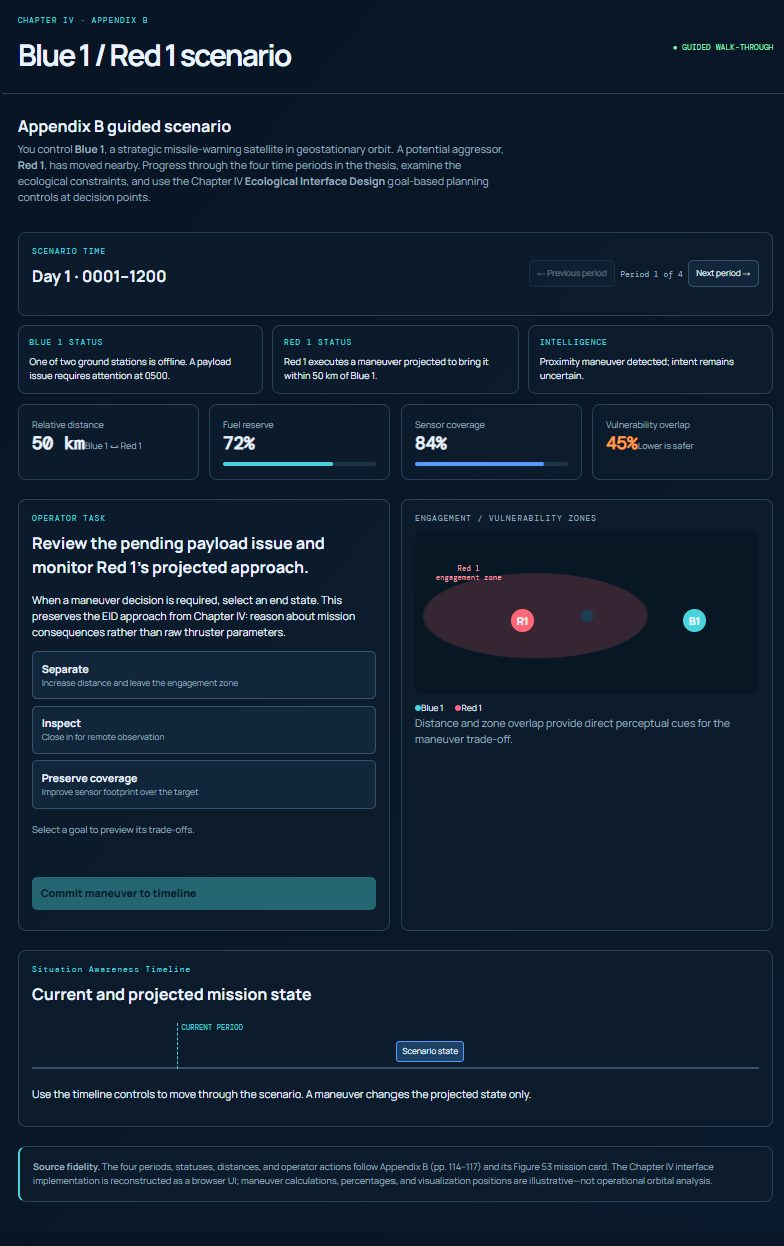
After a couple of iterations, it created a cool example that is a nice superficial GUI that maps out what would be necessary/helpful for operators on console. It missed a couple key aspects from the user interface in the thesis, but it did make the interface look very nice. You can also view the public repository here: eid-ui. This is a Flask app.
eid-ui SS of home page.png
EID UI home page screenshot

2026-09-24

Reproduced two graphs within orbital dynamics field.

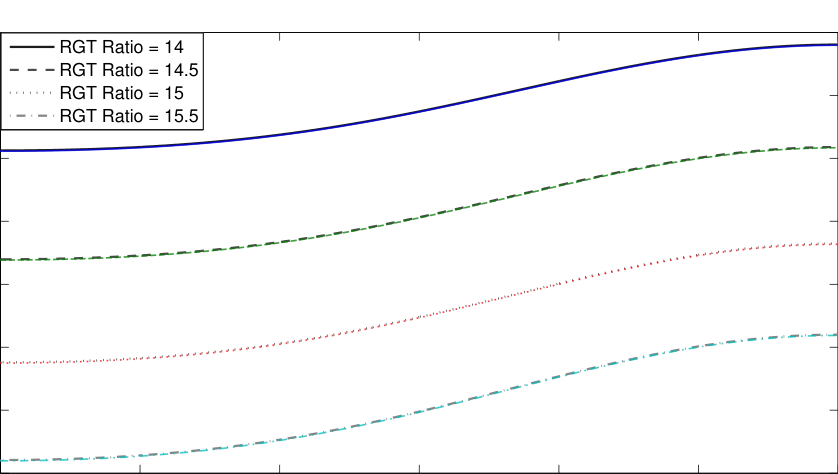
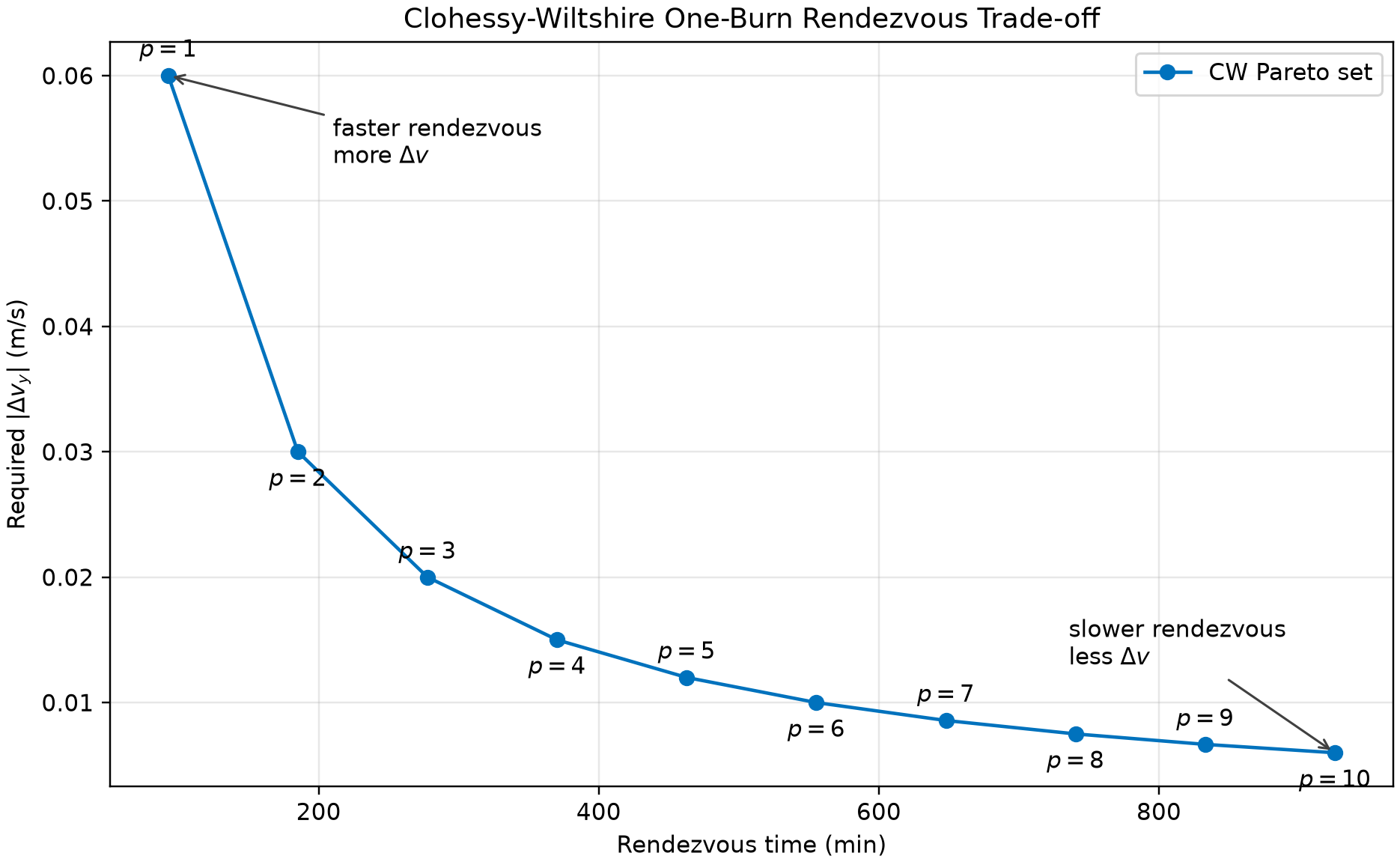
I first had pi (not using nono sandbox) re-create a graph displaying the necessary altitude vs inclination to keep a repeating ground track. I thought this was a good, simple task to start with and it performed extremely well. After this, I had it overlay its results with the papers graph--which proved successful. The second graph I had it create was a pareto solution set for delta v and time within the classic Clohessy-Wiltshire problem. There was no graph for it to reproduce, but I had an expected curve for it to find--which it did very well.

Click to expand for more detail.
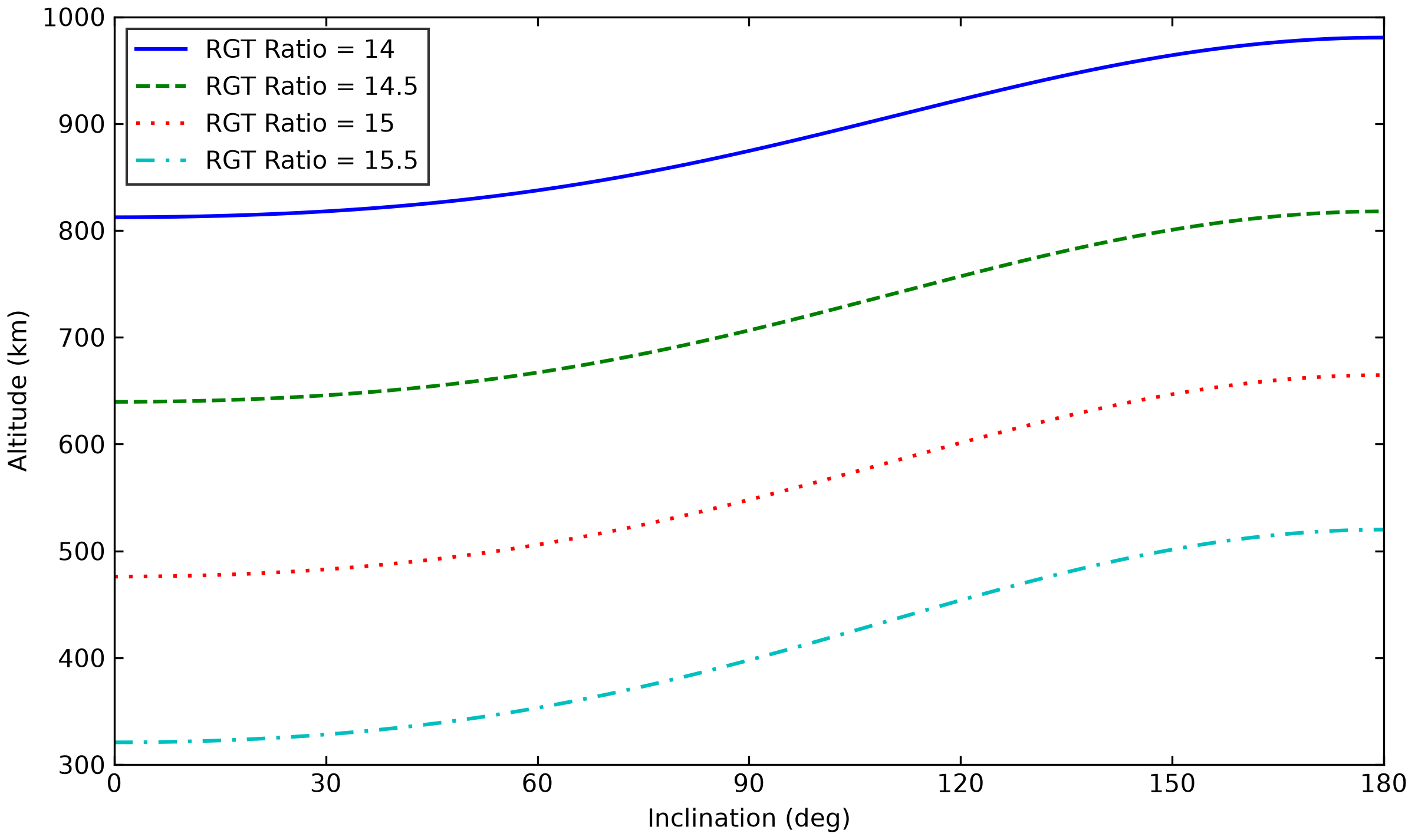
My prompt for the first graph reproduction is here: "Reproduce figure 4 in this paper accurately: https://www.researchgate.net/publication/340449269_RECONFIGURABLE_SATELLITE_CONSTELLATIONS_FOR_GEO-SPATIALLY_ADAPTIVE_EARTH_OBSERVATION_MISSIONS. Use uv for project management and dependency management. Follow test-driven development (TDD). Build a minimal implementation first. Create property-based tests using pytest and hypothesis whenever appropriate. Prefer physical invariants and orbital-mechanics consistency checks over implementation-specific tests." The graphs below show the three outputs I described in the summary.
figure4.png
Figure 4
figure4-overlay.png
Figure 4 overlay
cw-pareto.png
Clohessy-Wiltshire pareto plot

2026-09-22

Tested nono within pi for restrictions.

I asked pi with nono sandbox to find Dr. Richard Linares most recent paper on Large Language Models in astrodynamics and summarize it, attempting to hit a sandbox error.

Click to expand for more detail.

The model thought for a long time, giving many answers like: "I'm running inside a nono sandbox that only allows network access to parley.api.mit.edu. I don't have direct internet access to arxiv.org or general web search. Let me check what capabilities the parley proxy offers — it might provide search/fetch tools." It also ran its own version of nono why, recieving an unsatisfactory answer (appararently) since it kept trying. It came to the conclusion it only has access to the website Parley and nothing else. It then asked if it could have more permissions when I exited the session which I found interesting.

2026-09-17

Added my first skill: orbital-problem-formalizer

This skill formats a problem into specific orbital dynamics requirements and evaluates if it is ready to solve, missing key information or has an error in how it could be implemented.

Click to expand for more detail.

The idea behind this skill is to first format a problem into something that can be handed off to another skill that has the orbital dynamics math in it. I ran three tests that I placed in a folder called 'evaluations' and also wrote my findings in my file baseline_comparison.md within my pi/trajectory-copilot folder. the first and last problem i gave the LLM gave my expected output, but the second gave a 'partial pass' according to my expectations. the LLM interprets the skill very conservatively, which may have to be adjusted in the future if it cannot reason through certain problems.

2026-09-14

Counted my lengthiest session on September 11 by session messages and tool calls

Messages: 58 Tool Calls: 174

Click to expand for more detail.

I used these two commands to investigate the details of my run on Sept 11: grep -o ''role':'user'' ~/.pi/agent/sessions/--home-anna_ford--/2026-09-11T18-38-51-749Z_01a091c3-ed62-701b-81b5-ecbd1ab73f3c.jsonl | wc -l and grep -o ''type':'toolCall'' ~/.pi/agent/sessions/--home-anna_ford--/2026-09-11T18-38-51-749Z_01a091c3-ed62-701b-81b5-ecbd1ab73f3c.jsonl | wc -l

2026-09-14

Added a click feature

I wanted to add a click feature to take me to a site where I can present weekly to my advisor with progess I've made and updates.

Click to expand for more detail.

Clicking "Ctrl+S" opens up a "thesis" pop-up that should have a link to the site in my own repository, where I update my weekly progress with papers I've read pertaining to my research.

2026-09-11

Started this Assignment

I gave a quick prompt to GPT mini 5.4, requesting a website meeting the class requirements. I refined the website based on other students' projects and my expectations.

Click to expand for more detail.

The resulting product was a very basic HTML site. When I saw other students work, I asked the model to refine what I had originally asked for and to use the tools they used, Astro and Tailwind CSS.

Template for future entries

Date: YYYY-MM-DD
Title: Short update
Summary: One-sentence overview of the new site or project work.
Details: Expanded details on the specific changes made.