Dev Log
Notes on progress, decisions, and things I'm learning along the way.
November 16, 2026
A slightly late walkthrough and core contribution update
The Walkthrough Part: This was helpful for essentially summarizing my attempt to build the skill that maps an equation to the hooks of the US3D code. It also shows the agent's desire to check the mapping for this one particular equation that I never gave it with the gradient of the potential. I think it's a nice highlight of what I've failed to be specific about as well.
For contributions: The goal core contribution for this project is to build the workflow for building custom plugins in US3D without it being incredibly tedious. This would be a good contribution because digging out the necessary hooks is non intuitive and difficult since the source code is black-boxed due to being commercial. The tough part is verifying the hooks. Most are not under the same name as any variable I would be inputting and subsequently it makes it difficult to ensure the agents are finding the right hooks. If it were as simple as CTRL-F, I would have done it by myself already. My current plan to check it is to try to find some example plugins that implemented similar equations and see if the initial hooks align. Otherwise, the plan will be to directly check each hook by hand.
November 4, 2026
The AI wants to do too much + working on new plan
Now that a new plan has been generated, I've begun to work through the tasks. Task 1 was mostly just finding a way to take an inventory of all my reference files and realizing I had not clearly defined a deliverable. This was resolved -- it is a map of all the files for the agents to reference for quicker searches (hopefully).
Task 2 was an interesting experience with Astra. The idea was to generate a skill that could take a user's input equations and reference the library of materials quickly to pull out which potential hooks may be needed. Astra churned for about 5 minutes before I stopped it. It had tried to generate 10 different examples to verify against, which I had not specified explicitly. Upon verifying with the details in my Task 2 for backlog, there was no reason for Astra to do this to satisfy the requirements. Notes to me: Move the items in acceptance criteria to also what we use to assess completion.
However, because I ask the agent to double check what it has done before a backlog item can be marked completed, this has been a bit less chaotic than last time.
November 3, 2026
Replanning the project + some pdf surgery
To start with a clean slate, I have archived the previous backlog plans and skills generated with it. The user manuals were broken into smaller pdfs so that agents are able to refer to the summaries and then reference the relevant chapters more easily as opposed to filtering through hundreds of pages, a to do item from the pod clinics. These files remain unpublished on the git repo since they are literature. Example templates for code structure and submission scripts are also integrated.
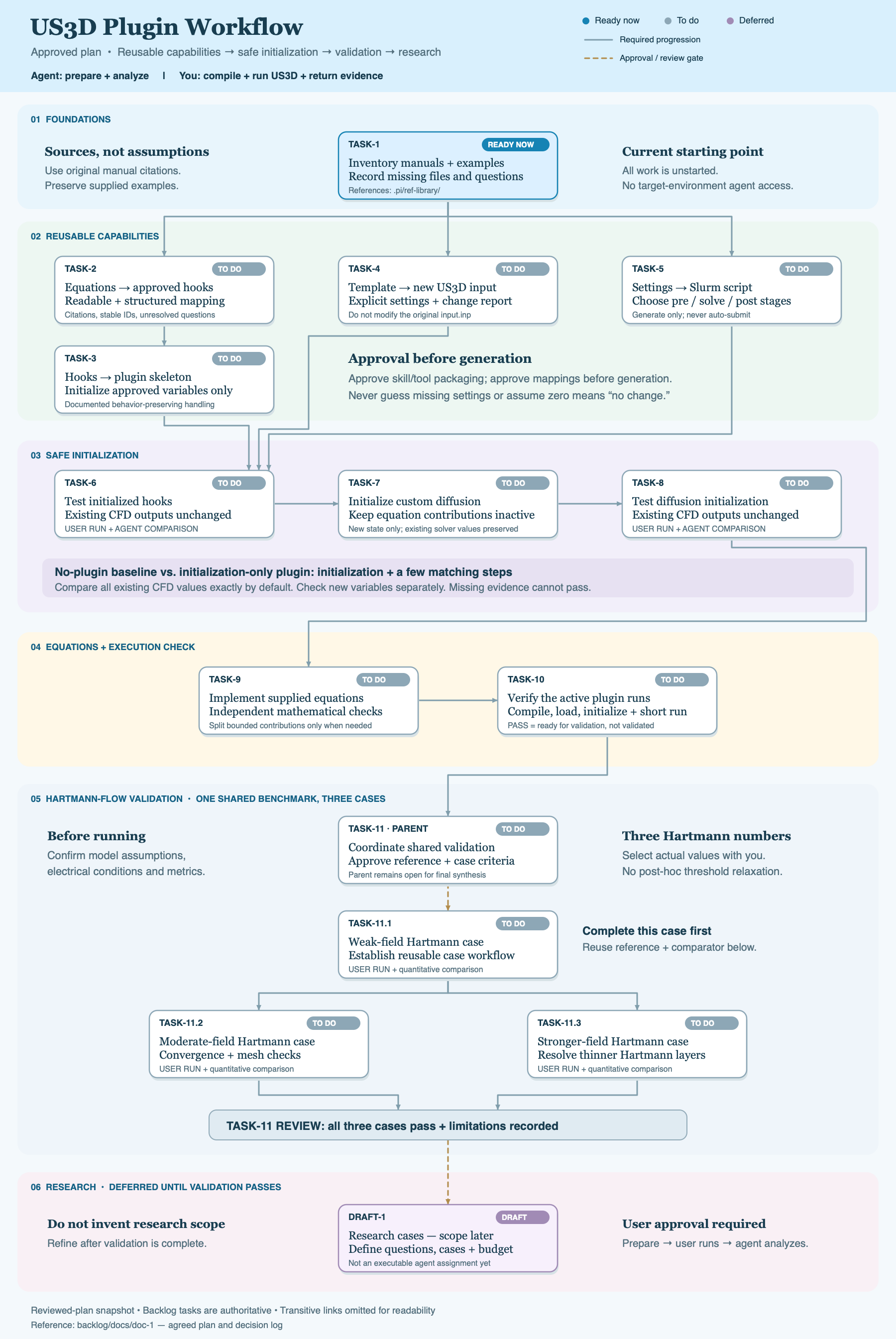
I then went through and generated a plan without agentic support. After that I submitted it to Astra with the specific task of reducing the items into tasks that less complex agents could complete. This workflow is highlighted in the below image. One goal was to keep the tasks of identifying hooks and building plug in templates as broad and general as possible so that these skills may be used for developing other physics plugins if desired.
November 1, 2026
Yes Manned Too Close to the Sun
In giving the agents too much freedom, the backlog plan has gotten out of control. Tasks are redundant or overlap, and I'm at this point unclear what the project needs. Need to revamp the repo and try to start with a clean project. Hopefully better results coming soon.
October 21/22, 2026
More Updates with Skills
Modified the skills I made last time, but there seems to be a bit of overlap as to what’s going on, so now a lot of the skills overlap. The current skill being worked on is hook-capability-mapping. The intent is for it to intake an equation or calculation and output the hooks required. The skill references the summaries of the manuals and seems to have a formatted output of the hooks I should need. This brings up the question of an efficient way to verify that the hooks it looks up are accurate for my needs.
Also the new Sonnet (5.5) was overly helpful with updating the dev log. This is the first time an agent has just written the entry without my permission. All of the others have asked me for what I want.
October 21, 2026
Astra and I had an adventure
I used Astra for this. I had it deploy subagents to go through all of the US3D documentation that I supplied it (about 400 pages). It churned for about 20 minutes, before I realized all the subagents were using Astra as well. I paused it and had it complete the task using Sonnet (it used Sonnet 4.6). There are now summaries for all chapters for the agents to reference in the future. In all, it took about 30 minutes and spent about $20.
I went through the Backlog tasks more carefully, and the agent seems to overestimate its capabilities in the breakdown of tasks, so spent some time breaking down the tasks more thoroughly. The new tasks are smaller, and hopefully will not overwhelm the less complex agents. I am currently a bit unsure about whether I would like the documentation references to be broken down into a specialized agent or a skill, since the current plan is to deploy subagents to find the necessary hooks for equations I would like to implement, so they would all ideally be able to quickly navigate the documentation.
October 14/15, 2026
Beginnings of Specialized Agent Implementation + a little Housekeeping
I spent some time to set up backlog and download the subagents extension. I also added the assignments page, so the website should be easier to use to see class progress.
In Backlog, I used GPT’s Sol 6 to plan out my entire project. The current tasks seem reasonable, but I’m sure they will need to be broken down further as the project progresses, as demonstrated by the attempt to build a specialized subagent. I started with Sonnet 5.5 for this, asking it to set up the architecture for the agent, as given in class notes. Issues were immediately encountered in just trying to navigate it to the reference files. I have large manuals that list the hooks for the solver. When pointed to the files to write a SKILL that would reference these files, the agent tried to read them and then broke. The terminal was requesting access to all kinds of things (I’m not sure why), and even after stopping the command, the entire session was unusable and would error after every input.
This leads into the following issue. Current subagent doesn’t work since I don’t think it can actually handle reading through the large pdfs I currently have in my reference library (not uploaded to GitHub). Next steps would be to try to refine the files and cut down all unnecessary fluff by hand or with a more powerful agent. GPT Sol ended up writing the current skills for the specialized agent, but I need to refine my references so that smaller models can handle them cleanly without bugging out again.
September 30, 2026
Figure Recreation and some New Skills
Tried starting out with GPT-Nano, before switching to Terra and Sonnet. Nano would be overly verbose about all the commands I gave it before repeating them back to me when the task was not super clearly specified (poor on my end too, but it was quite unforgiving unlike Terra or Sonnet).
Creating the skills was pretty easy. I used the SKILL.md template this time instead of trying to prompt it from scratch. That was a lot faster. Definitely need to go back and review the TDD skill more carefully, but for now the capabilities seem to match what I have been Googling and seeing thus far. For the recreation of the figure skill, I had it emulate WebPlotDigitizer capabilities.
I then had two independent agents write tests (first) and then recreate a figure from Richard Peterson's "Codesign of Plasma Avoidant and Plasma Embracive Antenna Topologies for Hypersonic Applications." It did a pretty good job in terms of the image looking very similar. It passed all the tests the other agent wrote. A step I should take to examine this more closely is to double check the tests and calculated values further, but that will take a bit to backtrack the math since some of these values were pulled from CFD simulations.
September 23, 2026
Fixing Skills, Trying out Sandboxing, and Fixing Up the Project Page
Skills: Resolved the issue that pi had been telling me all along, but I wasn't reading the top when it wasn't loading, oops.
Sandboxing: I have mostly been running pi with nono throughout the class and was somewhat familiar with the fact that it can only access the files within the working directory. I tried playing around with getting it to run commands such as git add . and git commit, not expecting it to work. It is pretty good at finding workarounds and was able to add by using the temp folder. This is something to keep in mind for the future to consider with commands that I wouldn't expect it to be able to run. Also tried to make a separate profile with the slides commands, but that one had the ability to read+write in my config files so that got scrapped pretty early on; this is definitely something to look into again.
Updating Website: Switched to Opus to evaluate some concerns and break down fixing the website aesthetics into bite-sized tasks, which it did well although it cost ~$2 to go through 10 aesthetic concerns. Ultimately I decided I like the 2009 blog look. For the image I have, I made that in Powerpoint and tried to have both Terra and Sonnet try to generate a less clunky image. They did not succeed.
September 22, 2026
Some More Playing Around with Skills
Since it has been uncertain about whether the skills were actually being imported, I directly loaded it with /skill_name. It was interesting because the agent (Claude Sonnet 5) immediately just began to perform the skill. It dug out the example data cases and executed the skill without verifying whether the data was the intended file. The skill markdown file has since been edited to clarify this. I'm still a bit unclear about when the skill is invoked outside of directly doing it, so that is something to look at in the next couple of days.
September 21, 2026
Week 2: Skills and Project Proposal
The project proposal has since been uploaded to the Project page. When giving it the details for the project proposal, I wanted it to upload the information that was in my Word document. The agent (Claude) was "unable" to find the file two times despite being prompted with the the exact file name. It is interesting how it often asks for more access when in the sandbox that currently exists, although I may be overly suspicious.
For developing the skills file, I had a relatively generic one, with specified details for generating a script to make a figure that would then go into a research paper. The agent (Claude Sonnet 5) was quite easy to generate the content for the file. Then generating figures in the same session was relatively robust. However, consequent sessions that were new did not follow quite as well. I definitely need to write more specifications, as the scripts are quite verbose and overly long compared to scripts that I would write. This occured for both Sonnet 5 and Sol. I'm still quite unfamiliar with skills and not quite sure if it actually is following these skills. I would benefit from spending additional time with the agents to further specify the skills files so that they do not result in overly verbose scripts and making sure it's actually following the skills.
September 14, 2026
Week 1: Site Creation
Since I have no experience with creating websites, Claude Sonnet 5 did the vast majority of the heavy lifting with the formatting and creation of the pages. I had the agent create the site using html, with the original reference files from the class website Astro files. It ended up deleting them. The easter eggs were remarkably easy for it to implement, requiring only a single prompt.
Changing colors or fonts required multiple prompts, and the agent often insisted that the colors had all been changed one way or another when it had not. The insertion of pictures also had a brief hiccup with paths, although this was more likely due to unspecific prompting on my end.
The animation and easter egg pop ups were quite fun to brainstorm and the agents did a great job. It was definitely faster than doing it on my own, and I was quite impressed with how smooth the process was. Log entries and larger text blocks were manually input.